

The Real Story Behind AI Buzz: A Handbook for Stressed-Out Leaders
TL;DR
You face a tough choice. How much time do you invest in learning AI for your own productivity? Where do you invest for your team, and when do you make your move? The back-and-forth between "AI will transform everything" and "AI is just hype" and “AI will destroy us all” isn't just confusing. It can be tiring, even for me, and I’m known for being passionate about the potential impact of AI (the positive and the not so positive).
If you feel overwhelmed or like you're the only one who doesn't understand, you're not alone.
What I've learned:
Hype surrounds actual breakthroughs. Hype does accompany many “breakthroughs,” but only time proves whether they are real breakthroughs. Meanwhile, the J-curve is real (more on this below).
The 95% failure rate of AI pilots (per MIT study) isn't your fault—it shows systemic challenges in how companies try to change. The AI tech works (usually); organizations struggle to adapt. That's a change management problem, not a personal shortcoming.
We sometimes make decisions based on “experts” that don’t have our best interests in mind. Hype from all angles sells, but what sells is not always reality. The people who shout the loudest often have skewed motives. We hear from those who aim to grab attention, not give accurate info. The real experts who could help you often get drowned out in all the noise.
The worry you feel isn't about AI taking your job. It is deeper than that. It is about finding purpose, losing professional identity, and having a say in a world that seems more and more unpredictable. That's a human worry.
The big changes will happen without much fuss. Just like we don't think about electricity anymore, AI will make its biggest mark when we stop obsessing over it.
Where I stand:
We are not hearing the truth from the “experts” and the “luminaries.” We hear the ones that make the wildest claims, because they make the wildest claims… not necessarily the accurate and honest claims. They have something to gain.
AI implementation success depends much more on the human factor than the tech. People. People. People. That is true whether we are implementing AI for ourselves or for our teams. Accounting for and dealing with the feeling of “breathlessness” when AI does something for us that we would have considered impossible yesterday and which threatens what we do every day is a fundamental thing that must be accounted for when implementing AI. AI threatens our sense of who we are.
Why This Matters Now
You're Not Imagining It—This Is Tough
Each generation thinks its tech moment is unique, but usually they're off the mark. But the AI buzz is different from what came before, and we should acknowledge this before we jump into frameworks and analysis.
The dot-com bubble grew from companies without income. The crypto bubble came from tech looking for a problem to solve. AI is not like that: it's based on tech that already does more than we ever thought it could (mostly), is already part of the world economy, and is already creating significant productivity gains (at least at the individual level). More than 70% of businesses say they use AI in some way in 2024 . You use AI-powered services without a second thought. This creates a puzzle that baffles simple analysis. The tech is real. The apps are real. Yet the market values, forecasts, and promises don't match what AI can do today. OpenAI CEO Sam Altman even said investors are "overexcited about AI" and "people will overinvest and lose money." You're not dealing with mere fantasy. You're facing reality wrapped in distortion. It is no surprise it's draining.
The Human Cost We Don't Talk About
Before we dive into the strategic stakes, let's take a moment to think about the emotional toll. You've experienced that feeling, maybe in the middle of the night, or during a meeting where everyone seemed to nod along with confidence where you wondered: Am I the only one not getting this? Is everyone else moving forward while I'm lagging behind? You've felt confused after reading two articles on the same day that say opposite things. One claims AI will wipe out half of all jobs; the other insists it's just a fad that will soon fade away. Both come from experts with credentials. Both make a strong case. You've felt that sinking feeling when a stakeholder asks about your "AI strategy," and you've had to act confident while thinking to yourself: I don't know the right answer here. If this sounds familiar, know that this doesn't mean you lack smarts or skills. Even the brightest people in the world are grappling with this too. The info landscape is broken. The reward system favors confidence and hype over truth. And the tech is changing so fast that what was right yesterday might be wrong today. The worry, the feeling of being a fraud, the fear of falling behind, these make sense given how crazy things are. You're not confused because you're not smart enough. You're confused because people who benefit from your confusion are puzzling you.
The Stakes Are Real—Both Ways
The stakes cut both ways, and that's what makes this so stressful. Over-investing has an impact on burning capital on pilots that never scale (95% fail to deliver ROI according to MIT research), chasing transformations your organization isn't ready for, and to create expectations you can't meet. It means you'll need to tell your team why the project you backed didn't pan out. It means feeling dumb. Not investing enough means watching rivals get more done in certain tasks, missing your chance to build up your company's skills, and ending up three years behind. It means you'll have to explain why you didn't see it coming. The MIT study shows that less-skilled workers can do up to 35% more work with AI help. This suggests the gap between companies that use AI and those that don't could grow fast. Neither choice is safe. I wish I could say something different. But dealing with that unease instead of acting like you're more sure than you are is the best way to handle it.
The Back-and-Forth Is Ruining Our Faith
Maybe the worst part of what's happening now is how it's breaking down trust. We're going through what I call a "faith slump.” You've seen it before: exciting news about big steps forward, then quiet admissions of problems, then pushback, then more exciting news. When Google's AI Overviews came out, people made fun of them for suggesting to put glue on pizza even though the models behind them got great scores on tests. This back-and-forth hurts everyone. It is frustrating that thoughtful leaders are being manipulated by an attention-driven system that rewards overstatement. It bothers me that the people who should guide you through this are often making the situation worse. You should have access to better information. You deserve honest uncertainty instead of false assurance.
Making Sense of It
First, Let's Be Clear About What "Hype" Means
I want to share a method that's helped me understand this mess. It's not the final answer - I don't have one of those - but it's helped me tell the important stuff from the noise. Hype is different from:
Real excitement about tech that works
Advertising that shows a product in a good light
Guessing what might be possible in the future
Passion from experts who see true worth
Hype means making people expect too much, beyond what facts support. It happens because systems reward those who exaggerate. It's the difference between what we're told to expect and what we should expect based on real evidence.
By this definition, AI has real hype. Sequoia Capital's study reveals a "$600B revenue gap" and that was in 2023. This gap shows the difference between what people spend on AI tech and the actual money end-users bring in. This gap proves the overblown expectations. The 95% pilot failure rate indicates that expectations consistently outpace reality. But the hype isn't the same everywhere. And this is where things get interesting.
The Layers of Hype (They're Not All Equal)
AI hype varies across different aspects. Once I saw this, things became clearer... and the following is only a small list of the type of AI hype that is out there.
Technical Hype: Statements about what the technology can do. I believe this is the least exaggerated layer—AI truly does amazing things. The exaggeration happens at the edges: claims of "reasoning" or “consciousness” that is complex pattern matching, benchmarks that don't work well in messy real-world situations.
Market Hype: Statements about money to be made. This is exaggerated, at least for many companies (although some companies will see big financial benefits and new giants will emerge). The circular funding patterns, for example, where NVIDIA puts money into customers who then use that money to buy NVIDIA chips, should make us think twice. The Atlantic'sanalysis brings up valid worries about how much "demand" comes from real needs versus artificial creation.
Social Buzz: Talk about AI's effect on society and jobs. People blow out of proportion in both ways. Rosy and gloomy forecasts both go way past what we can prove. The MIT study discovered "no clear link between AI exposure and shifts in overall employment" as of October 2025. That should make everyone less sure about their bold predictions. However, there will be a big impact. But what that will mean remains uncertain.
Overblown AGI Hype: Statements about AGI and superintelligence. This is guesswork. The 2023 Expert Survey showing median estimates for "high-level machine intelligence" around 2040 shows uncertainty, not a forecast.

Why People Can't Stop Talking About AI
Three things make it tough to get over the AI buzz:
The Tech Works: Unlike digital money or virtual worlds, AI has shown its usefulness.
The Big Players Are Already Set: NVIDIA, Microsoft, Google, and Amazon make loads of money no matter which apps take off. They want to keep the excitement going.
You Can't Prove Predictions Wrong: Will we see AGI in 5 years? 20 years? Never? The range is so big that everyone can say they were right.
Who Gains From Your Uncertainty
This feels awkward to mention, but it matters: everyone you hear from gains if you remain uncertain and worried.
Sellers gain from overblown expectations that boost sales
VCs gain from buzz that boosts portfolio values
Scientists gain from buzz that pulls in funding
News outlets gain from buzz that draws clicks
Leaders gain from buzz that backs "change" plans
Advisors (yes, I see the irony) gain from buzz that creates a need for guidance
Notice who's left out: folks like you who need correct info to make choices.
The whole reward system aims to create buzz, not fix it. This isn't a plot. It's all about incentives. But knowing this can help you see the scene more clearly .
What the Evidence Shows
Getting to the Heart of What We Know
Here is what I believe. Productivity gains are real, especially at the individual level. The FederalReserve Bank of St. Louis found workers are 33% more productive in hours they use GenAI leading to a 1.1% overall productivity increase. A study of customer service agents by NN Group showed a 14% average boost in productivity, with less-skilled workers seeing gains of up to 35%. These numbers matter. They're not insignificant either. AI use is widespread but shallow. By 2025, 78% of companies say they'll use AI, but it's not integrated into main workflows yet. The 95% failure rate for pilots points to lots of testing, but not much actual use.
Scientific applications are clear winners. AlphaFold has changed protein structure prediction. Over 3 million researchers use it. Drug discovery now takes less time. For most, though, the return on investment is still hard to pin down. Only about 30% of AI leaders say their CEOs are happy with the returns on a typical investment in generative AI.
A Truthful Overview
| Claim or Topic | Evidence Provided | My Stance |
|---|---|---|
| AI Pilot Success Rate | MIT study showing ~95% of AI pilots fail to deliver measurable ROI | Failure reflects systemic change-management gaps, especially unaddressed concerns about professional identity, more than technological limits. |
| AI Productivity Gains (Individual) | Federal Reserve Bank of St. Louis findings on GenAI use by workers | Individual productivity gains can be significant but are highly context-dependent. My own gains have been substantial. |
| Corporate AI Investment Returns | Typical investment in generative AI initiatives | ROI remains difficult to quantify for most organizations. Improvements are real, but mapping them cleanly to P&L is still rare. |
| J-curve of AI Adoption | MIT manufacturing study showing early performance declines | Initial drops are a normal part of human and organizational transition. Leaders must manage perception and impacts before gains appear. |
| Market Revenue Gap | Sequoia Capital analysis showing a large gap between AI spend and revenue | Valuations and expectations are broadly inflated relative to current profits. There will be clear winners and many losers, as always. |
| Software Development Performance | METR study examining outcomes for top-tier coders | Benchmarks often overstate real-world results. Still, individual developers usually see meaningful productivity gains with the right use. |
| Impact of AI on Overall Employment | MIT study (Oct 2025) finding no clear link between AI exposure and job shifts | Claims of imminent mass unemployment remain unproven, but there are definitely cases of downsizing associated with AI. I do expect widespread job redefinition and the elimination of some types of roles, especially below senior responsibility tiers. |
| Customer Service AI Impact | Nielsen Norman Group study of customer service agents | AI raises productivity overall, with the strongest benefits for less-skilled workers when guidance and escalation paths are clear. |
However, these facts don't clear up all the questions. Research can be flawed. Situations evolve. I've made mistakes before, and I'll make them again. But this is the clearest picture I can paint from the proof we have.
Tough Lessons
The Hype Puzzle
Somewhat accurate forecasts about game-changing tech often come across as overblown. In 1995, saying the internet would shake up retail, media, and how we talk to each other seemed like wild exaggeration. It was also true. The dot-com bubble popped, wiping out billions. But the shake-up happened anyway. The hype was both off the mark (many online businesses failed) and right on target (the world changed). AI seems to have a similar trend. Most specific forecasts are likely to turn out at least partially wrong. But the general idea—that AI will change how we work—looks right. The gains in productivity are real even if they're smaller than what was promised.
I've made mistakes here too. I've been too doubtful about things that ended up mattering, and too quick to believe things that didn't. It's hard to balance doubt and openness. The practical lesson I've learned: bank on the direction, not the timing or size. The change is happening; the schedule can be flexible.
The Voices You're Hearing Aren't the Voices You Need
It is upsetting that the real experts who could help you often get drowned out by those who can't. Think about what happens when an AI researcher shares balanced findings: they get little attention. But when they make wild predictions like AGI in five years! Or AI will wipe out humanity! they grab headlines and get invited to speak. This isn't about being corrupt; it's just how attention-grabbing works. The experts you hear from most are good at getting clicks, usually not at being right. An article from the National Center for Biotechnology Information showed this. People tended to lean towards easy-to-understand arguments, not the best ones. Here's what this means in practice: don't trust extreme views and look for voices that people aren't hearing. The most correct opinions often don't go viral.
Your Organization Isn't Broken—It's Just Human
The 95% failure rate worries many leaders I speak with. But the issue isn't the tech, and it's not your specific company. It's that companies are built to fight change. Work processes and chain of command, reward systems, and company culture all push for things to stay the same. AI poses a threat to all of these at once. The "J-curve" of AI adoption shows how productivity goes down at first. This matches what an MIT study found when looking at manufacturing companies. On average, these companies saw their productivity drop by 1.33 percentage points at the start. Some older companies even saw drops as big as 60 percentage points. But this doesn't mean it's failing. It's just part of the normal messy way humans deal with change. So if you're having trouble with your AI projects, you're not alone. Many others are in the same boat.

This Is About Who We Are
I believe that our heated AI discussions aren't about the tech itself. They're about our worries over our own importance and purpose. Pay close attention to what people are saying. The real concern isn't that AI will fail; it's that it'll succeed. What does it mean if machines can write, think, and make things? What's left that's human? What's my worth in a world where brainpower is everywhere? I've dealt with this myself. I've seen AI's capabilities and felt a bit uneasy about my own future role. I bet you've had similar thoughts. These emotions are real. They're not crazy. They show that the world is changing around us. The takeaway is to understand that your reaction to AI relates to your own sense of self, not just the tech. Being upfront about this—even if it's just with yourself—can help you think more clearly . And we need to remember that those around us are feeling the same feelings.
What To Do Next
Practical Steps
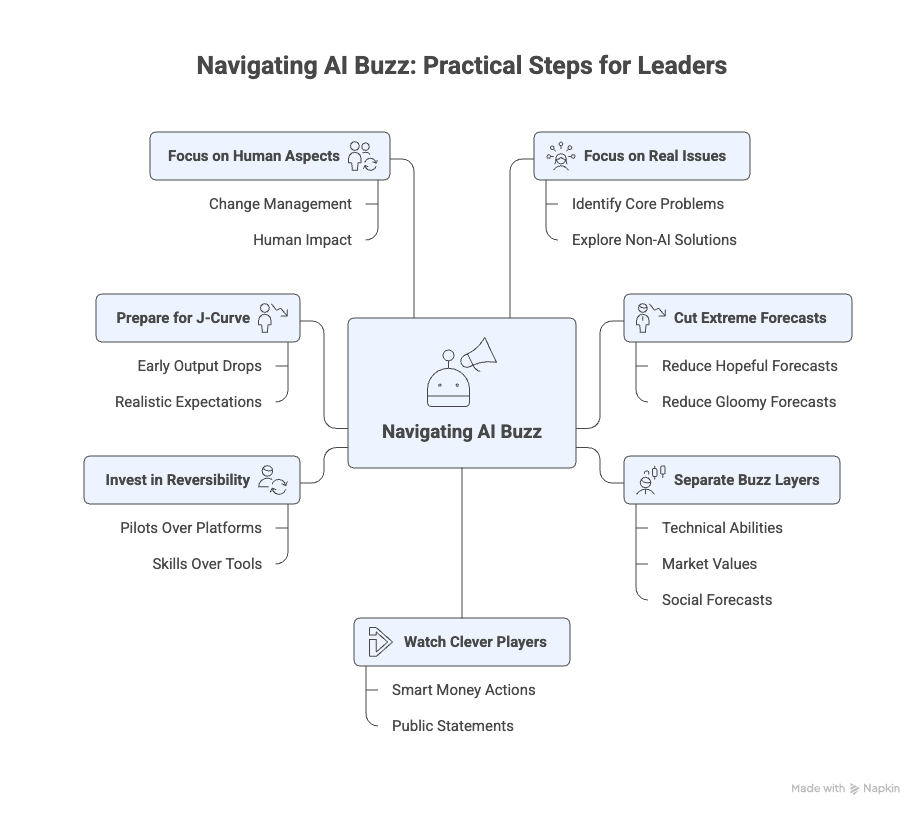
Focus on your real issues, not the technology. What's slowing down your work? AI is one answer; make sure you have a question worth asking… and remember there are answers other than AI.
Cut extreme forecasts in half at least. Whether they're hopeful or gloomy extreme views get attention, not accuracy.
Separate the layers of buzz. Technical abilities are more trustworthy than market values, which are more dependable than social forecasts.
Watch what clever players do not just what they say. The actions of smart money - choosy, careful - tell a different tale than public statements.
Put money into reversibility. Choose bets you can undo. Pilots over platform promises. Skills over specific tools.
Get ready for the J-curve. Early drops in output are common. Set expectations to match.
Most of all, focus on the human aspects of change.
How to Assess What You're Hearing
Look at motives. Who profits if people buy into this idea?
Look for details. "AI cut processing time by 40% in this workflow" is better than "AI will change everything."
Ask for timelines. Predictions without dates can't be proven wrong.
Look for evidence that goes against the claim. The strongest argument holds up even when faced with opposing facts.

Emotional and Psychological Advice
This part is often left out of most business tips, but I think it's important:
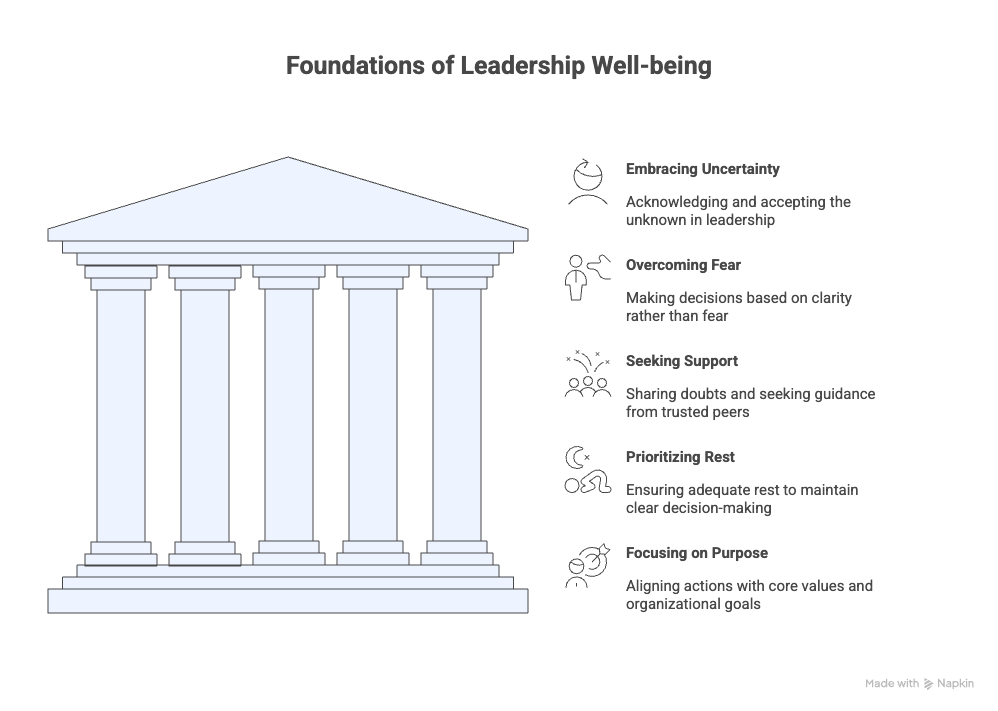
Allow yourself to not know everything. You don't need to have all the answers. No one does. Leaders who act like they do are either lucky or not telling the truth.
Be aware when you're making choices out of fear rather than clear thinking. Being scared of falling behind is a bad guide. Take a moment to breathe. How would you act if fear didn't hold you back?
Open up to those you trust about your doubts. Being a leader can feel lonely. Seek out other leaders who'll admit they're also unsure. It can make a difference.
Guard your rest time. This might seem small, but your choices suffer when you're worn out. The AI updates can wait till you wake up.
Focus on what matters to you and your organization. Beyond all the planning and rivalry, what are you aiming to create? Who do you want to help? These goals don't shift just because tech does.
Guiding Your Team Through This
Be clear about the unknowns. Your team knows you don't have every answer. It's honest to say, "We're taking chances with limited facts."It has an influence on building trust instead of wearing it down.
Make room to learn, not just do. Companies that learn fastest will come out on top. Set up ways to get feedback. Praise learning from mistakes, not only wins.
Talk about who we are. Your team worries about staying useful and finding meaning just like you. Own up to it. Saying "I know this is shaky ground. Let's work it out together" goes far.
Put people first. Every AI setup that works well points to the same thing: it's about changing how people work. The tech part is simple. People are what counts.
Final Thoughts
Big talk comes with big changes. Any tech that matters causes a stir. The buzz is a sign of significance, not a denial of it. The issue isn't if the buzz is warranted—it's both overblown and pointing to something genuine, at the same time.
AI will change how we work. The path is obvious even if the schedule and range aren't. That's as much certainty as anyone can provide. But here's what I hope you'll remember more than any structure or review: You're not by yourself in this muddle. The brightest folks I know are grappling with the same issues you are. Leaders across all sectors share your worry.
The doubt is real, and it's fine to feel it. The groups and leaders who will succeed aren't those who gamble first or biggest. They're the ones who keep a level head when everyone else is confused—those who can handle uncertainty without freezing up. This kind of clear thinking doesn't come from knowing everything. It comes from being upfront about what you're unsure of. It comes from caring more about getting it right than looking clever. It comes from being kind to yourself and your team while you tackle something tough.
You can handle this. Not because it's simple—it's not. But because you're smart enough to ask the right questions. That's more than most people can say. The AI revolution is happening.
The buzz is also real. And you moving between them with humility and good judgment—that's what this situation needs.
I'm rooting for all of us.
A frequent speaker and community builder, I also mentor students, advise startups, and support global education initiatives—all while dividing my time between my home/office in New Hampshire, my kids and Mom in Massachusetts and everywhere else in a small RV that serves as my mobile command center. Learn more about me, my company Optimal Campus Consulting, and my desire to give backhere. If I can assist you in any way, email me at [email protected] or justget in touch here.
What AI-related challenges are you facing? Feel free to comment below.