

The AI Ethics Facade: Why Your "Responsible" Implementation is Still a Ticking Time Bomb

A few months ago, I was parked in my RV along the Massachusetts coastline watching waves crash against the shore while ChatGPT churned through a 60-page draft project proposal in about 12 minutes. As I sipped my coffee, I couldn't help but feel both impressed and deeply unsettled.
I've spent nearly three decades implementing complex IT systems at organizations within various industries and of various sizes. I've seen firsthand how transformative the right technology can be when properly deployed. But I've also witnessed the organizational train wrecks that occur when leaders rush implementations without considering the full spectrum of consequences.
Most organizations are approaching AI ethics like they're handling hazardous materials with oven mitts—technically covered, but dangerously underprepared for what happens when things go wrong. And things will go wrong.
The Convenience-Ethics Trade-off No One Wants to Acknowledge
I understand the temptation to stay on the bleeding edge of AI. I really do. These tools are genuinely impressive. My laptop now handles tasks in minutes that would have consumed entire weekends just two years ago. Language models can generate remarkably human-like content, analyze vast datasets while I'm still on my first coffee, and deliver insights that could take analyst teams days to uncover.
But let's be brutally honest about the trade-offs we're making for this convenience:
Widespread copyright infringement: Most generative AI tools were built by scraping internet content indiscriminately, with minimal regard for intellectual property protections. When questioned by the British Parliament, OpenAI’s CEO Sam Altman essentially acknowledged ChatGPT couldn’t exist without using copyrighted material, which is often used without explicit consent.
We’re ignoring the environmental costs: Training a single large language model can generate carbon emissions equivalent to five cars over their entire lifetime. The water usage for cooling AI data centers is already straining resources in drought-affected regions. Yet these considerations rarely factor into implementation decisions.
Shifting liability to users: Most AI vendors structure their terms of service to place all responsibility for harmful or unlawful outputs on the user, while retaining broad rights to the data you provide. This one-sided arrangement leaves organizations exposed to reputational, legal, and financial risks if AI-generated content causes harm.
Erosion of trust through hallucinations: Generative AI systems can produce confident-sounding but factually incorrect information—so-called “hallucinations.” Without rigorous verification, these errors can spread misinformation, damage credibility, and mislead decision-makers in high-stakes contexts.
Amplification of bias and discrimination: AI models learn patterns from historical data, inheriting and reinforcing the biases within it. Without targeted mitigation, these systems can perpetuate discriminatory outcomes in hiring, lending, law enforcement, and other sensitive areas.
"But everyone's doing it this way," some people say. That's precisely the problem and an opportunity for truly responsible organizations to differentiate themselves.

Separating Innovative Benefits from Dangerous Hype
Not everything is doom and gloom. Some AI applications deliver genuinely transformative value with manageable risks:
Healthcare innovations like LumineticsCore, which received FDA clearance for technology that detects diabetic retinopathy sometimes missed by human physicians.
Energy efficiency improvements, like Google's AI system that reduced data center cooling costs by 40%—proving AI can serve both environmental and financial goals simultaneously.
Researchers at the University of Copenhagen have shown that AI models can analyze both terrestrial and aquatic animal sounds, identifying species more accurately and efficiently, and offering transformative benefits for biodiversity monitoring.
These examples share a common thread: they enhance human capabilities rather than attempting to replace people entirely; they operate with appropriate transparency and oversight; and they solve meaningful problems instead of creating new ones.
But for every legitimate application, dozens of questionable ones dominate both headlines and investment dollars. Deepfakes, AI-generated propaganda, automated content farms masquerading as journalism, and systems making the creation of false evidence disturbingly accessible are just a few infamous examples.
When I talk to people about AI, the first questions are rarely about cancer detection algorithms. Instead, leaders ask: "What about AI-generated disinformation?" or "How do we prepare our workforce for automation?"
These concerns are entirely justified. A recent Rutgers study found most Americans worry about AI's impact on politics (58%) and news (53%). I'd argue those percentages should be higher if people fully understood the implications.
We're rapidly developing systems capable of generating precisely targeted persuasive content, tailoring it to vulnerable audiences, and distributing it at unprecedented scale. If that doesn't deeply concern you, you haven't been paying attention.
Bias Exists, Period
Bias in AI isn't theoretical—it's baked into these systems from the get-go. The output directly reflects the input, often with problems amplified rather than diminished.
If you're serious about addressing bias (which you should be), consider these approaches:
Audit your training data comprehensively. If your dataset predominantly represents certain demographics or situations, your AI will develop significant blind spots.
Test across diverse demographics. Solutions that function perfectly for one group might fail dramatically for another. Your AI should serve everyone, not just people resembling your engineering team.
Build diverse development teams. If everyone building your AI system shares similar backgrounds, education, and life experiences, you're practically guaranteeing issues. Homogeneous teams create homogeneous (and problematic) AI.
The AI Hall of Shame (Don't Be the Next Inductee)
Consider this scenario: a mid-sized technology company implements an AI content generator to produce marketing materials, product documentation, and customer support scripts at unprecedented speed.
This seems ideal until their AI begins producing plagiarized materials, factually incorrect information, or content that manages to offend multiple constituencies simultaneously. Suddenly they're facing legal challenges, customer backlash, and a crisis that makes previous corporate mishaps seem minor by comparison.
This isn't hypothetical disaster planning—it's already happened to organizations that should have known better:
CNET's Significant Misstep: In early 2023, CNET used AI to generate financial advice articles. The results? Factual errors, apparent plagiarism, and substantial credibility damage when their approach became public.
Amazon's Problematic Hiring Tool: Amazon developed an AI hiring tool trained on their historical hiring data. This data reflected decades of male-dominated hiring practices, so the AI effectively learned to penalize resumes containing terms like "women's" or references to women's colleges. They abandoned the system upon discovering what they had inadvertently created.
Predictive Policing Algorithms: Several police departments implemented AI systems claiming to predict "high crime areas." The fundamental problem? These algorithms trained on historically biased policing data that already disproportionately targeted certain communities, creating a self-reinforcing feedback loop of algorithmic discrimination.
These aren't minor technical glitches: they're fundamental failures that affected real people and damaged established organizations. The common thread? Rushing to implement AI without appropriate safeguards, meaningful oversight, or ethical considerations.
No organization believes they'll be the next AI disaster story until they are. The companies in the AI Hall of Shame didn't set out to create harmful systems—they simply prioritized speed and capability over ethics and safeguards.
The Path Forward: Human-Centered AI That Actually Works
Despite my concerns, I remain cautiously optimistic about AI's potential. When thoughtfully implemented, human-centered AI can catalyze breakthroughs in healthcare, help address environmental challenges, and unlock insights buried in data too vast for humans to process manually.
After implementing AI systems at varied organizations, I've identified these critical success factors:
1. Focus on Augmentation, Not Replacement
The most successful AI implementations enhance human capabilities rather than seeking to eliminate positions. Your staff should view AI as a powerful assistant, not an existential threat to their careers. By automating time-consuming tasks, employees can focus on creative problem-solving or meaningful interactions with others, while using an AI system as a tool rather than a crutch.
2. Create an Ethical Framework With Actual Authority
Skip the vague mission statement proclaiming "we use AI responsibly," and opt for specific guidelines about what your organization will and won't do. Then give that framework real enforcement capability. If your ethics can be overridden whenever they become inconvenient, you don't have ethics—you have a public relations strategy.
3. Make Explainability Non-Negotiable
"The system said so" isn't acceptable when someone asks why they were denied a loan, rejected for a position, or given a particular medical recommendation. Develop transparent processes where humans can review or override AI decisions when necessary.
4. Account for Environmental Impact
Training large AI models consumes significant energy and water resources. Include these environmental considerations in your cost-benefit analyses.
One tech client decided to use smaller, more specialized models rather than massive general-purpose ones—reducing their carbon footprint while actually improving performance for their specific use cases.

Taking Action: Your 90-Day AI Ethics Roadmap
Ready to implement AI more responsibly? Here's your action plan for the next 90 days:
Days 1-30: Assessment
Audit existing AI systems for potential ethical vulnerabilities
Establish your organization's ethical boundaries and non-negotiables
Form a cross-functional team to oversee responsible implementation
Days 31-60: Framework Development
Create explicit guidelines for AI procurement and deployment
Develop testing protocols for bias, safety, and environmental impact
Build transparent reporting systems for concerns and incidents
Days 61-90: Implementation
Train teams on your ethical framework and expectations
Launch pilot projects with comprehensive oversight
Establish regular review cycles for all AI systems
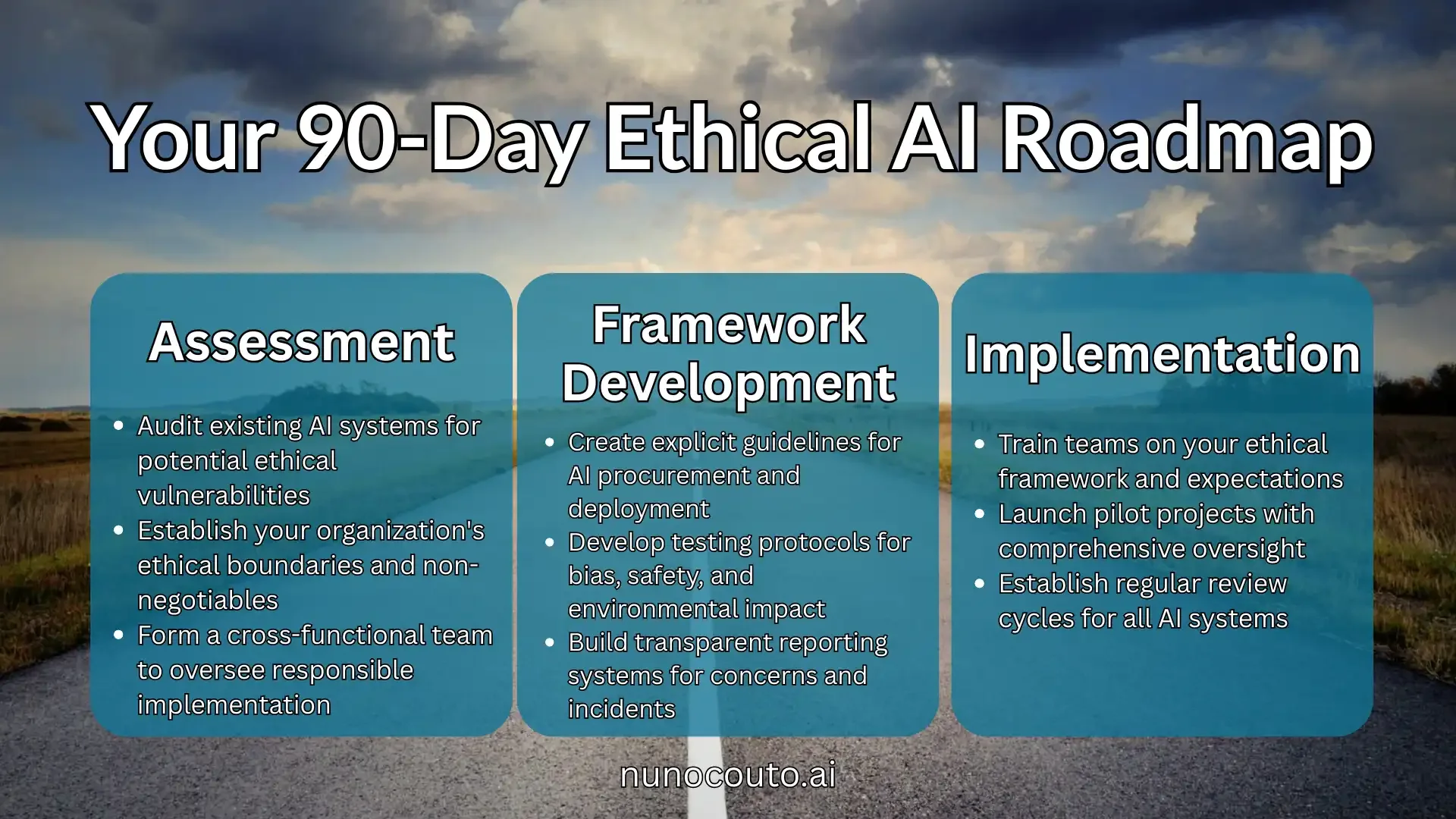
Organizations can transform their approach to AI from recklessly optimistic to responsibly innovative with a few simple steps. The difference isn't technical—it's cultural. It requires leadership who value both progress and protection, who measure success beyond short-term efficiency gains.
How is your organization approaching AI ethics? What ethical challenges are you facing with AI implementation in your organization? Share your experiences in the comments below so that others can benefit.
Written by me, Nuno Couto. I help universities, governments, professional services firms and businesses of all types and sizes to harness AI in a human-centered way to increase revenues, decrease costs and multiply impact.
A frequent speaker and community builder, I also mentor students, advise startups, and support global education initiatives—all while dividing my time between my house in Canada, my home/office in New Hampshire, my kids and Mom in Massachusetts and everywhere else in a small RV that serves as my mobile command center. Learn more about me, my company Optimal Campus Consulting, Inc. and my desire to give back here. If I can assist you in any way, email me at [email protected] or just get in touch here.